
Endometriosis is a disease complex that affects about 1 in 10 women, according to data from Inserm. This condition is characterized by the presence of tissue similar to the uterine lining outside the uterus. This leads to chronic inflammatory reactions that can severely impact women's health.
It is crucial to recognize the early signs of this condition. Ignoring these symptoms can turn this disease into an invisible disability, permanently affecting quality of life. In this article, we will explore the mechanisms of endometriosis and how it can affect several organs.
As the ultimate guide, our goal is to inform women about the clinical realities and current medical advances in France. By raising awareness of this disease, we can better support those who suffer from it.

Key Points
- 1 in 10 women is affected by endometriosis.
- The disease causes chronic pain and inflammation.
- Recognizing early signs is essential for better quality of life.
- The condition can affect several organs in the body.
- It is important to stay informed about medical advances in France.
Understanding Endometriosis: Definition and Issues
This complex disease affects many women around the world. Endometriosis is now recognized as a systemic disease, affecting several organs beyond the uterus. Endometrial tissue, similar to the uterine lining, reacts to hormonal changes each month, causing pain and bleeding.
Early recognition of this disease is crucial. It helps limit irreversible damage to the pelvic and abdominal organs. Inserm experts emphasize that this condition is a major public health issue. Understanding endometriosis helps women better navigate their care journey.
| Aspects of Endometriosis | Impact |
|---|---|
| Systemic disease | Affects several organs |
| Hormonal reaction | Causes pain and bleeding |
| Early recognition | Limits damage |
| Public health issue | Impact on quality of life |
The Signs and Symptoms of Endometriosis
Identifying the symptoms of this disease is crucial for improving quality of life. Pelvic pain is often the first sign felt by women. This pain can be particularly intense during menstruation, thus affecting their daily lives.
Pain can also occur during sexual intercourse, a symptom frequently mentioned in clinical recommendations. In addition to pain, some atypical symptoms, such as digestive or urinary disorders, may manifest.
These varied symptoms illustrate the complexity of endometriosis. The impact on quality of life is significant, affecting both professional and social life. It is common for symptoms to worsen over time, making medical management all the more essential.
- Pelvic pain is a major symptom.
- Pain during sexual intercourse is common.
- Digestive disorders may also occur.
- The impact on quality of life is significant.
- Symptoms can worsen without appropriate treatment.

Diagnosis of Endometriosis
The diagnosis of this complex disease represents a real challenge for many women. In France, the average time to obtain a diagnosis is estimated at 7 years. This can lead to prolonged suffering and a diminished quality of life.
Doctors often start by using pelvic ultrasound to detect abnormalities. This examination is essential for identifying structural problems in the female reproductive organs. However, for deeper lesions, MRI is a crucial complementary examination.
In some cases, a laparoscopy may be necessary to confirm the diagnosis. About 40% of women suffering from chronic pelvic pain do not receive an adequate diagnosis. This underscores the importance of better training for medical practitioners.
| Diagnostic Methods | Use |
|---|---|
| Pelvic ultrasound | Detection of structural abnormalities |
| MRI | Mapping of deep lesions |
| Laparoscopy | Confirmation of diagnosis |
| Diagnostic delay | About 7 years on average |
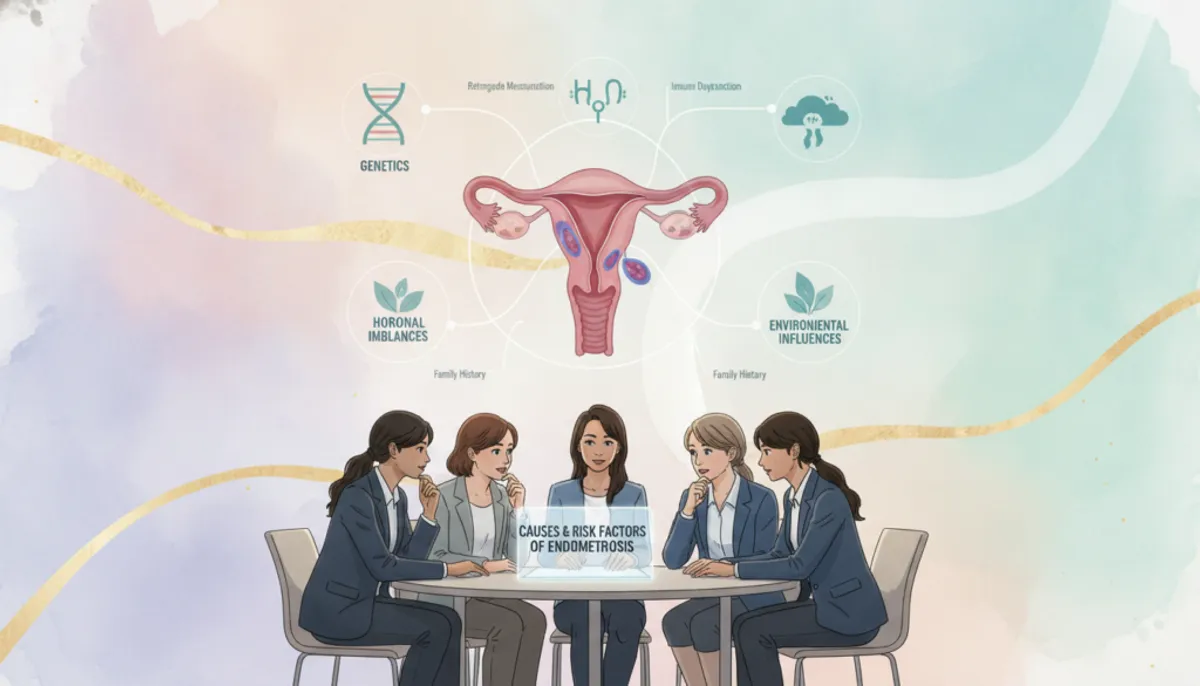
Causes and Risk Factors of Endometriosis
The causes of this disease remain mysterious, but several theories attempt to explain its origin. One of the most well-known is the implantation theory, proposed by John A. Sampson in 1927. This theory suggests that menstrual blood flows back into the abdominal cavity, causing the formation of tissue similar to that of the uterus.
Recent research has also highlighted the role of genetic factors. Although no single gene has been identified, family history increases the risk of developing this disease. Additionally, exposure to endocrine disruptors is considered an important environmental factor.
Another fascinating aspect concerns the link between the microbiota and inflammation. Japanese researchers have discovered that the bacterium Fusobacterium may influence endometrial inflammation. Finally, it is important to note that the risk is higher in women who have had early menstruation, before the age of 12.
- The implantation theory suggests menstrual reflux.
- Genetic factors increase the risk of the disease.
- Exposure to endocrine disruptors is concerning.
- The microbiota, particularly Fusobacterium, plays a potential role.
- Early menstruation before age 12 increases the risk.
The Clinical Forms of Endometriosis
There are several clinical forms of this disease, each presenting distinct characteristics. These forms can influence diagnosis and treatment. Understanding these variations is essential for effective management.
Superficial, Ovarian, and Deep Pelvic Endometriosis
Superficial endometriosis manifests as implants localized on the surface of the peritoneum. These lesions are often difficult to detect by standard imaging. On the other hand, ovarian endometriosis is characterized by the formation of cysts called endometriomas. These cysts contain dark fluid resembling chocolate.
The deep pelvic form is particularly concerning. It involves lesions infiltrating more than 5 mm beneath the peritoneum. In 50% of cases, the uterosacral ligaments are affected. These lesions can also reach the rectum (20-25%), bladder (10%), and vagina (15%), causing severe functional pain.
It is important to note that there is no direct correlation between the type of lesions and the intensity of the pain experienced by the patient on a daily basis.
| Type of Endometriosis | Characteristics |
|---|---|
| Superficial | Localized implants on the surface of the peritoneum |
| Ovarian | Cysts (endometriomas) of dark fluid |
| Deep pelvic | Lesions infiltrating more than 5 mm beneath the peritoneum |
| Rectum | Affected in 20-25% of cases |
| Bladder | Affected in 10% of cases |
| Vagina | Affected in 15% of cases |
Treatments and Management of Endometriosis
Managing this disease requires a varied and tailored approach. The High Authority of Health (HAS) recommends a multidisciplinary strategy to meet the needs of patients. This includes medical and surgical treatments, depending on the severity of symptoms.
Hormonal contraceptives are often the first line of treatment. They help control the growth of endometrial tissue and reduce pain. Anti-inflammatories and analgesics are also used to relieve acute pain, although they do not cure the disease.
For more severe cases, surgical intervention may be necessary. This operation aims to remove the lesions and restore the function of the affected organs. Thanks to regional care pathways, patients now have access to expert centers for optimal management.
| Type of Treatment | Description |
|---|---|
| Hormonal contraceptives | Used to limit the growth of endometrial tissue |
| Anti-inflammatories | Prescribed to relieve acute pain |
| Surgery | Removal of lesions in case of failure of medical treatments |
| Multidisciplinary approach | Collaboration between gynecologists and urologists |
Endometriosis and its Impacts on Daily Life
The repercussions of this disease on women's daily lives are often underestimated. About 30% to 40% of women with endometriosis encounter infertility issues. This can be devastating for those wishing to start a family.
Chronic pain is another major aspect. It profoundly alters quality of life, impacting not only professional life but also personal relationships. Women may feel isolated and misunderstood.
In some cases, endometriosis remains asymptomatic. This means it is only discovered during an unsuccessful fertility assessment. The biological mechanisms linking this disease to infertility include mechanical barriers on the tubes or altered uterine receptivity.
Managing infertility may require in vitro fertilization. Success rates vary depending on the severity of the lesions. Thus, understanding the impacts of endometriosis is essential for improving patient care.
- Infertility affects about 30% to 40% of women.
- Chronic pain severely impacts quality of life.
- The disease can remain asymptomatic in some cases.
- Biological mechanisms affect fertility.
- In vitro fertilization may be necessary in some cases.
Research and Advances in Endometriosis
Recent advances in research on this disease are promising. Indeed, innovative projects, such as ComPaRe-Endometriosis, have been launched to better understand this pathology. This project, which began in 2018, involves about 10,000 women volunteers. Their participation is essential to deepen knowledge about the heterogeneity of the disease.
At the same time, researchers are looking into specific genes, such as NRSP1. Inhibition of this gene has shown a reduction in inflammation in mouse models. This opens the door to innovative non-hormonal treatments.
Here are some key advances in this field:
- The ComPaRe-Endometriosis project mobilizes 10,000 women for research.
- Studies on the NRSP1 gene aim to develop innovative treatments.
- Inserm coordinates projects to identify factors influencing the disease.
- Salivary tests, such as the Endotest, are being evaluated for non-invasive diagnosis.
- Scientific advances seek to provide personalized solutions for patients.
Resources and Support for Patients
The resources available for women affected by this disease are essential. Many associations play a key role in supporting patients. They offer practical guides for better living with the disease.
The national strategy launched in 2022 by the French government aims to improve the overall management of affected individuals. This strategy is based on three pillars: research, training, and care pathways.
Regional care pathways, such as Endo-IDF, coordinate the journey of patients throughout French territory. This allows for better referral to specialized expert centers.
Raising public awareness is a priority. It aims to prevent the normalization of pain in young menstruating women. Patients can also contact trained volunteers for advice on care pathways and locally available resources.
- Associations offer practical guides for better living with the disease.
- The national strategy aims to improve the management of affected individuals.
- Regional care pathways allow for better referral to expert centers.
- Public awareness is essential to change perceptions.
- Patients can benefit from advice from trained volunteers.
Conclusion
Understanding the issues of this pathology is essential for the well-being of women. Endometriosis is a complex disease that requires a multidisciplinary approach to improve the quality of life of patients.
Although diagnosis can take up to 7 years, increased awareness today allows for better recognition of early symptoms. Scientific research, conducted by institutions such as Inserm, opens promising perspectives for innovative and non-invasive treatments.
It is crucial that every woman has access to a coordinated care pathway within the French regional networks. By staying informed and supported, patients can better manage the impacts of this pathology on their daily lives and health.
FAQ
What is endometriosis?
Endometriosis is a disease where tissue similar to the uterine lining grows outside the uterus, causing pain and other symptoms.
What are the main symptoms of endometriosis?
Symptoms include pelvic pain, intense menstrual pain, pain during sexual intercourse, and sometimes infertility issues.
How is endometriosis diagnosed?
Diagnosis may include clinical examinations, ultrasounds, and sometimes an MRI to visualize the lesions.
What treatments are available for endometriosis?
Treatments may be medical, such as contraceptives or anti-inflammatories, or surgical to remove lesions.
Can endometriosis affect fertility?
Yes, endometriosis can cause infertility issues by affecting the ovaries, fallopian tubes, and uterus.
What are the recent advances in research on endometriosis?
Innovations in non-invasive diagnosis are underway, which could improve early detection of the disease.
How can patients find support?
There are associations that offer practical guides and support, as well as awareness initiatives in France.
What are the risk factors associated with endometriosis?
Risk factors may include family history, short menstrual cycles, and high estrogen levels.